Topic 3: Bonding & Structure
3A. Ionic Bonding (3.1 - 3.9)
Ionic bonding is the strong electrostatic attraction between oppositely charged ions. It leads to the formation of giant ionic lattices.
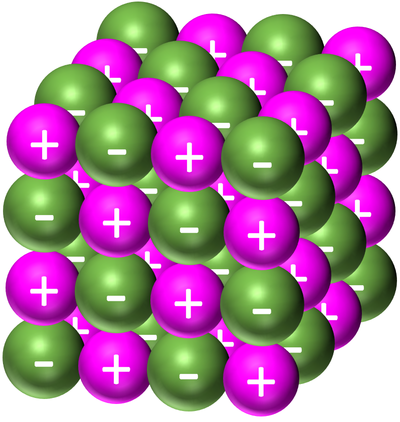
Evidence for Ions
- Electron Density Maps: Show discrete islands of electron density with zero density between ions.
- Electrolysis: Evidence includes the physical properties of ionic compounds and the migration of ions, such as colored ions moving toward oppositely charged electrodes.
Trends in Ionic Radii
For isoelectronic ions (e.g., to ), the radius decreases as the atomic number increases because the nuclear charge pulls the same number of electrons closer.
Ionic bonds can have covalent character if the cation distorts the anion's electron cloud.
- High Polarising Power (Cation): Small size, High charge (e.g., ).
- High Polarisability (Anion): Large size, High charge (e.g., ).
3B. Covalent Bonding (3.10 - 3.12)
Covalent bonding is the electrostatic attraction between two nuclei and the shared pair of electrons between them.
Dative (Coordinate) Bonding
A bond where both shared electrons come from one atom. Common examples include and the dimer .
Giant Covalent Structures
- Diamond: Each C bonded to 4 others. Tetrahedral.
- Graphite: C bonded to 3 others. Layers slide (soft).
- Graphene: Single layer of graphite.
3C. Shapes of Molecules (VSEPR) (3.16 - 3.19)
Electron pairs repel each other to be as far apart as possible. Lone pairs repel more than bonding pairs.
| Electron Pairs (Bond + Lone) | Shape | Bond Angle | Example |
|---|---|---|---|
| 2 BP, 0 LP | Linear | 180° | |
| 3 BP, 0 LP | Trigonal Planar | 120° | |
| 2 BP, 1 LP | Bent / V-shaped | 117.5° | |
| 4 BP, 0 LP | Tetrahedral | 109.5° | |
| 3 BP, 1 LP | Trigonal Pyramidal | 107° | |
| 2 BP, 2 LP | Bent / V-shaped | 104.5° | |
| 5 BP, 0 LP | Trigonal Bipyramidal | 120° & 90° | |
| 6 BP, 0 LP | Octahedral | 90° |
3D & 3E. Electronegativity & Metallic Bonding
Electronegativity: The power of an atom to attract the shared pair of electrons in a covalent bond.
- Polar Molecules: Non-symmetrical molecules with polar bonds.
- Non-Polar Molecules: Symmetrical molecules where dipoles cancel.
Metallic Bonding: Attraction between a lattice of metal ions in a sea of delocalised electrons. Conductivity depends on the ability of these electrons to move.
[Image of metallic bonding sea of electrons model]Practice Zone
Exam-Style Question: Molecular Shapes
Q1: Explain the shape and bond angle of the ion.
Click for Worked Solution
Step 1 (Electron Pairs): Oxygen is in Group 6. +1 charge means 1 electron lost. 5 valence electrons + 3 from Hydrogens = 8 electrons total. 4 pairs.
Step 2 (Bonding vs Lone): There are 3 Bonding Pairs (H-O) and 1 Lone Pair.
Step 3 (Conclusion): 4 pairs adopt a tetrahedral arrangement. 1 Lone Pair repels more than bonding pairs, reducing the angle from 109.5° to 107°. Shape is Trigonal Pyramidal.
Quick MCQ: Polarisation
Q2: Which compound is likely to show the most covalent character?
- A)
- B)
- C)
- D)
Click for Answer
Correct Answer: B. Aluminium () has the highest charge density (high charge, small size), giving it the greatest polarizing power.